
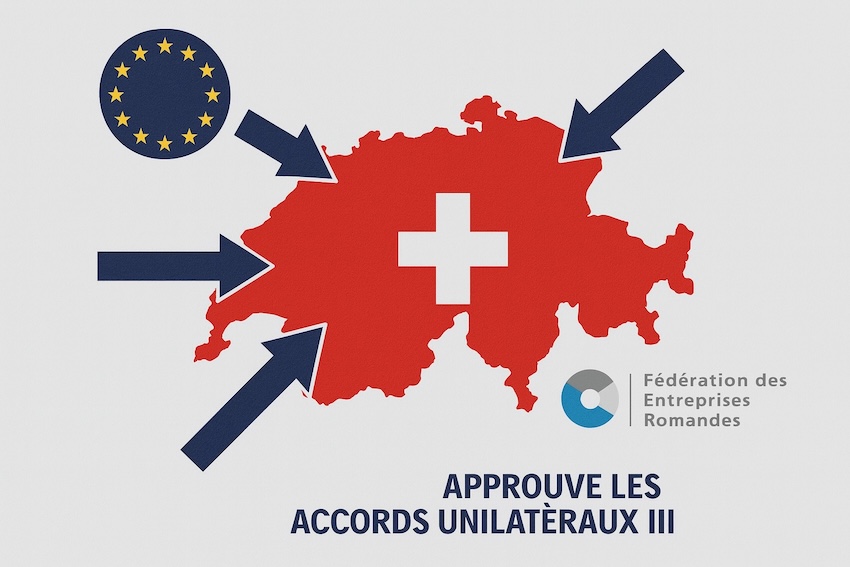
When those who claim to defend the economy of French-speaking Switzerland start talking like Brussels' mouthpieces, it becomes urgent to set the record straight. By supporting the «new agreements» with the European Union, the Fédération des Entreprises Romandes is not defending SMEs or Swiss prosperity. legal guardianship renamed “strategic opportunity”. This is not an economic analysis - it is a political renunciation. When a once-respected lobby echoes the EU's talking points word for word, it doesn't reveal a vision: it reveals a intellectual capitulation, It's a clear choice to forget what made Switzerland strong in the first place, and what still determines its freedom today.
There are positions that are mistakes, others that are blind - and there are some, more rare, that are the result of conceptual betrayal. The recent declaration by the Fédération des Entreprises Romandes (FER) in favour of the «new agreements» with the European Union unambiguously falls into the latter category.
The FER has not simply defended a questionable economic strategy: it has taken up point after point the language of Brussels, It goes against the fundamental interests of Switzerland, its sovereignty and its direct democracy.
And it has to be said clearly: these agreements are neither bilateral, balanced nor negotiated. These are Unilateral Agreements III, In other words, the adoption of European law without a seat, without a vote, without a veto - with compensatory measures in the event of refusal.
The FER knows this. Yet it persists.
1. The “bilateral” lie”
In its communication, the ERF speaks of ’deepening the bilateral path«, »economic continuity« and »regulatory stability necessary for employment«.
It's a clever, reassuring lexicon, calibrated to erase the essential: the actual content of the texts.
Because the proposed treaties establish a asymmetrical legal integration, Switzerland would be forced to adopt - automatically or almost automatically - whole swathes of European law. Parliament would have only a right of veto under blackmail, under threat of sanctions.
To call it «bilateral» is to rename a leash a «climbing rope».
2. The fiction of “guaranteed” prosperity”
The FER insists that these agreements are necessary to «guarantee market access».
This narrative masks two realities:
- There is no threat to free trade. It is based on the 1972 Agreement - autonomous, intact, legally sound and independent of the EU.
- Swiss competitiveness stems from freedom, not regulations imported from Brussels.
The real risk for our companies is not Swiss sovereignty, but European bureaucratisation, already responsible for over a million pages of rules and stagnant growth.
The choice is simple:
Does Switzerland want to be an agile economy - or a regulatory subcontractor to the EU?
3. The strategy of fear: the FER's favourite weapon
There's never a missing ingredient in these campaigns: the rhetoric of fear.
- «Loss of market access»
- «Employment risks»
- «Isolation»
- «Weakening of the export industry»
- «Uncertainties for our SMEs»
It's the usual recipe: replace analysis with the emotional blackmail.
But Switzerland must not abandon its model just because a few lobbies are afraid of having to innovate rather than fall in line.
4. Intellectual capitulation
The FER could have defended :
- regulatory neutrality,
- Swiss innovation,
- economic flexibility,
- direct democracy as a comparative advantage.
Instead, it has turned into a Economiesuisse's antechamber in French-speaking Switzerland, reciting the same litany:
«These include »stability«, »predictability«, »integration« and »partnership".
Hollow words, but effective in concealing a major renunciation:
the methodical abandonment of Swiss economic sovereignty.
Conclusion: Switzerland does not need a mouthpiece for Brussels
The FER claims to defend the economy of French-speaking Switzerland.
In fact, it defends a vision in which Switzerland gives up its freedom to organise its own market, its own rights, its own future.
A vision where Swiss companies cease to be sovereign - and become compliant.
Switzerland has never prospered by aligning itself, but by freeing itself.
It has never shone by submission, but by invention.
The Unilateral Agreements III are not the way forward.
They are a diversion from the bilateral path, a direct attack on direct democracy, and the admission of an economic elite that prefers the ease of obedience to the demands of freedom.
The FER has chosen its camp.
The Swiss people will choose their own.