
In an opinion piece published in L'AGEFI on 28 April 2026, economist Cédric Tille engaged in an academic high-wire act to attempt to demonstrate the impossible to us: The massive and continuous rise in the Swiss population would have no negative impact on our standard of living. For the former executive of the Swiss National Bank (SNB), the slowdown in GDP per capita growth would merely be a «side effect» of a gloomy global economic situation. Move along, there's nothing to see here. Mass immigration? A convenient scapegoat.
Yet, beneath the veneer of linear regressions and «non-significant» correlations, the Graduate Institute professor's analysis conceals a relentless macroeconomic reality that every Swiss citizen experiences daily. When one has spent their career in the hushed lounges of the SNB, one eventually confuses the real wealth of a people with the dematerialised asset lines of an accounting balance sheet.
Point-by-point dismantling of a technocratic fallacy.
1. THE FALLACY OF GDP PER CAPITA: THE ILLUSION OF SWISS RESILIENCE
Cédric Tille's argument: «Growth has slowed considerably, falling from 1.391% per annum before 2007 to 0.801% per annum since […] In fact, Switzerland is among the best off, with the slowdown being significantly less pronounced than elsewhere.»
Reality scrutinised:
To compare the Swiss decline to that of our European neighbours in order to rejoice is an intellectual imposture.
- The decline of real momentum A decline from 1.39% to 0.80% represents a a slowdown of nearly 421 basis points in the growth rate of the standard of living per capita in Switzerland. To describe this fall as «less pronounced than elsewhere» in order to normalise it is an admission of defeat.
- The average illusion Per capita GDP is a rough arithmetic average. In Switzerland, this residual growth of 0.801% is disproportionately captured by multinationals, the quasi-public sector and high finance, whilst the middle class is bearing the brunt of the erosion of its real purchasing power.
2. The Criminal Omission of Monetary Creation and Mortgage Debt
What Tille omits: The monetary creation mechanisms linked to demographic inflows.
Cédric Tille worked at the SNB. He knows full well how our financial system works, but chooses to exclude it from the equation:
- The private debt cycle: A larger population mechanically means an increased need for housing and infrastructure. In a system of fractional reserves, this need is financed by the creation of money out of nothing by commercial banks in the form of mortgages.
- The property bubble: This massive injection of liquidity has propelled Swiss mortgage debt to a stratospheric level of over 1,100 billion francs.
- The erosion of purchasing power Mass immigration directly fuels housing speculation. As a result, rents skyrocket, property prices become inaccessible for younger generations, and real disposable income plummets. What nominal GDP claims to measure as an increase is actually being destroyed by the cost of living.
3. HOURLY PRODUCTIVITY: THE STATISTICAL DECEPTION PARADOX
Cédric Tille's argument: «Growth in GDP per hour worked […] fell very slightly in Switzerland, from 1.221% to 1.161% (and even that is not statistically significant).»
Reality scrutinised:
If hourly productivity is holding up artificially (a minuscule fall of 0.061% quarter-on-quarter), it is precisely because the nature of our growth has changed:
- Extensive, not intensive growth: Switzerland is no longer creating wealth through innovation or efficiency gains (intensive growth), but through the massive influx of new workers (extensive growth).
- Infrastructure asphyxiation: This stagnation of productivity, coupled with population growth, results in overcrowded trains, saturated motorways, hospitals under pressure, and overloaded schools. These systemic costs (time lost in traffic jams, the degradation of public services) are never deducted from Tille's GDP. However, they constitute a Major and very real drop in living standards.
4. THE ZERO DEGREE OF CORRELATION: THE ART OF REJECTING CAUSALITY
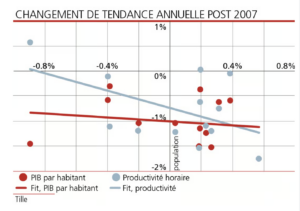
Cédric Tille's argument: «If an increase in population growth is associated with a decrease in GDP per capita [...], this link is weak. It is, in fact, not statistically significant.» (Referring to Chart 3 below, which he presents in L'AGEFI).

Reality scrutinised:
Cédric Tille's third graph shows a negative slope the red line of Fit (of GDP per capita). In plain terms: the more the population increases, the more GDP per capita growth decreases. But the author dismisses their own observation by stating that it is not «statistically significant».
- Statistical dilution By mixing economies with radically different structures (like Spain, the United Kingdom, or the United States) in the same graph, we dilute Swiss specificity.
- The Swiss exception is not a spontaneous miracle: If Switzerland sits slightly above the trend curve (the red and blue Swiss dots on Chart 3), it's not thanks to immigration, but despite herself. It is Switzerland's accumulated historical capital (its political stability, its historically strong currency against gold, its national savings) that cushions the blow. We are consuming our inheritance to mask the breakdown of our model.
CONCLUSION: TOWARDS A DOCTRINE OF REAL STABILITY AGAINST THE ILLUSION OF PAPER
Cédric Tille's analysis is a reflection of an ivory tower economic thought, the very one that led the SNB to offload 1,300 tonnes of our physical gold between 2000 and 2008 to accumulate foreign paper money and finance American debt.
You do not measure the greatness of a nation by the volume of its gross domestic product, but by the freedom and prosperity of its citizens.
«Gold is the currency of kings, silver that of gentlemen, but debt is the currency of slaves.»
The unbridled increase in population, supported by the credit tap of commercial banks and the complacency of the central bank, is a vehicle for real impoverishment. It destroys the middle class, artificially inflates global GDP for big business, while reducing each citizen's slice of the pie.
It is time to break free from the quantitative illusion of technocrats. Switzerland must rediscover the path of a qualitative economy, anchored in monetary sovereignty, the preservation of real purchasing power and respect for its territory. Our future will not be built on demographic overcrowding, but on the historical discipline that has made us strong.
Did this analysis resonate with you? Like and repost to help us reach a wider audience.
What the media keeps silent about, we analyse. What Bern negotiates, we dissect. https://test.souverainete-suisse.ch/
We are the Guardians of Independence. Join the Swiss Sovereignty Movement. Not tomorrow. Not later - now.